Tag: editorial processes

  • Guest Post: New Guide to Digitally Driven OA Journal Development, from Scholastica

    Guest Post: New Guide to Digitally Driven OA Journal Development, from Scholastica

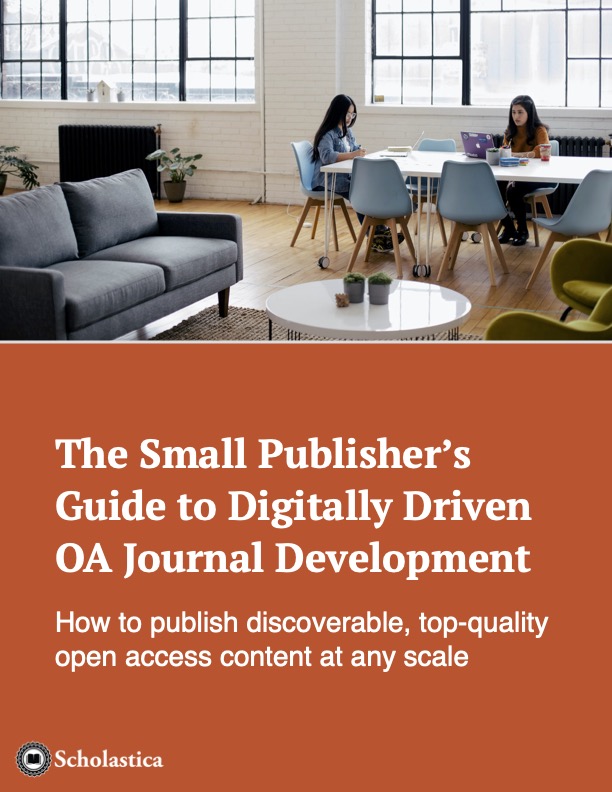
    We are pleased to feature a guest blog post from our conference sponsors, Scholastica, to tell you about their latest free eBook; The Small Publisher’s Guide to Digitally Driven OA Journal Development.

    The guide covers digital-first content production, hosting, and dissemination best practices publishers of any size can implement to scale their OA journal programs sustainably.

    From shifts in how readers find and engage with content to new archiving and indexing requirements and everything in between — there’s a lot for publishers to keep up with in the fast-changing research landscape. That’s why harnessing opportunities to publish more efficiently via digital-first workflows and content optimization is essential.

    The Small Publisher’s Guide to Digitally Driven OA Journal Development provides a blueprint for strategies publishers at any stage can follow to expand the reach and impacts of their journals while keeping up with the latest publishing standards and trends, including how to:

    ● Optimize journal websites for online readers and search engines
    ● Expand article indexing and meet new metadata recommendations
    ● Adopt a digital-first production process to publish more efficiently
    ● Establish clear policies for content and data archiving

    With OA costs incurred by authors and research institutions considerably outpacing inflation in recent years, there is a growing need for mission-driven organizations to develop sustainable OA journal models to foster a more equitable research future for all. And there has never been a better time for publishers of any size to produce modern OA journals, with more possible OA funding and online hosting options than ever before.

    This new free eBook is designed to help scholarly organizations publish high-quality OA journals affordably and disseminate new articles to the broadest possible readership. The Small Publisher’s Guide to Digitally Driven OA Journal Development is free to download at: https://lp.scholasticahq.com/guide-to-high-quality-open-access-journal-publishing/

  • European Science Editing unveils new Best Practice article type

    European Science Editing unveils new Best Practice article type


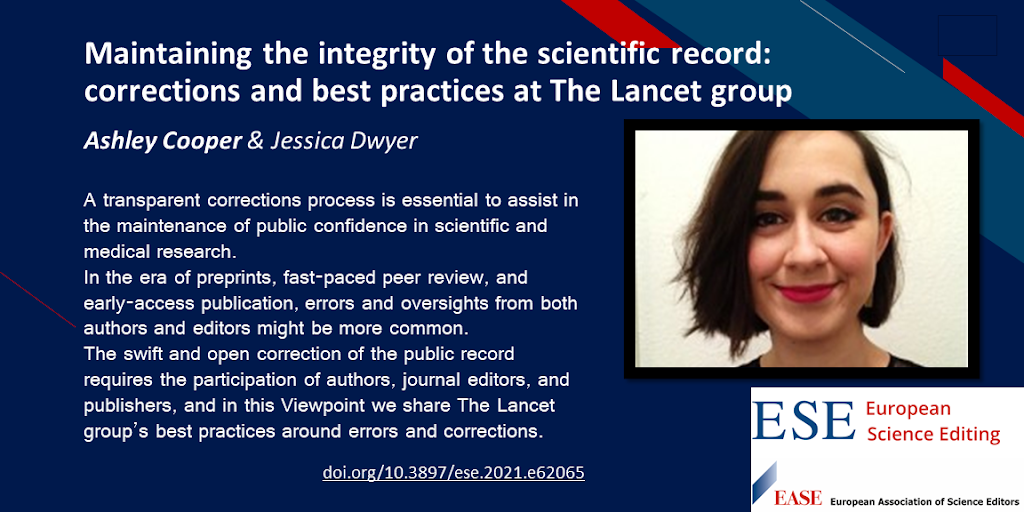
    We are pleased to announce the publication of a Best Practice paper in our journal, European Science Editing.

    Authoreed by Ashley Cooper and Jessica Dwyer, this article shares errors and corrections processes from The Lancet group of journals, and is an excellent showcase of our new article type.

    We encourage the submission of further articles of this type, which provide simple, practical advice on how to manage a particular aspect of the editorial and publication process – from peer review, to ethical practices, to copyediting, to enrivonmental awareness and office efficiencies and beyond!

    We would also welcome similar informative articles on new editorial techniques, initiatives and developments in science editing and publishing that showcase best practices in an editorial envirnment.

    Read this flagship article in full, in the journal, now!

    Cooper AN, Dwyer JE (2021) Maintaining the integrity of the scientific record: corrections and best practices at The Lancet group. European Science Editing 47: e62065. https://doi.org/10.3897/ese.2021.e62065

  • Lancet journals announce diversity pledge and no “manel” policy

    As part of the Lancet Group’s commitment to increasing gender equity, diversity, and inclusion in research and publishing, all of the publishing group’s 18 medical journals have adopted a new Diversity Pledge and No All-Male Panel Policy.

    The initiatives are outlined in a commentary written by Lancet Group editors, which states that they value diversity in all its dimensions and support the need to improve the inclusion in research and publishing of people across gender, ethnicity, geography, and other social categories.

    Dr Richard Horton, Editor-in-Chief of The Lancet, says: “We recognise that publication is a chief currency within science, medicine, and public health. It is key to the ability of women and people of colour to contribute, receive recognition, and accrue the experience, visibility, and achievement to compete for advancement. As editors and journals, we are just one part of an ecosystem that includes academic institutions and funders where gender bias is well-documented, and of a broader society that disadvantages certain groups to create an uneven playing field. But we are committed to be the change we want to see, and to playing our part in helping create diversity and inclusion in health research and publishing. We encourage other publishers, journals, and members of the science community to contribute to these pledges.”

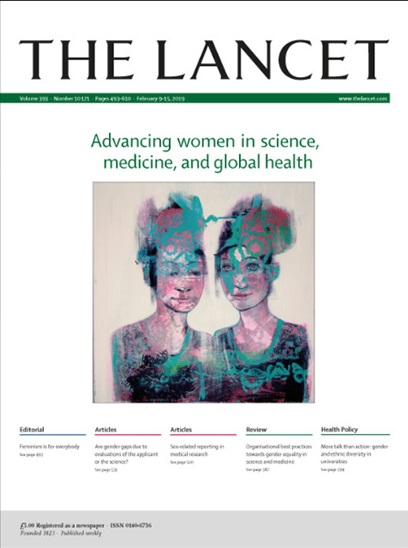
    These pledge and policy follow the Lancet’s special issue highlighting the lack of diversity and representation of women, people of colour, residents of the Global South in author, reviewer, and editorial positions, such as this article which determined that less than a third of authors and reviewers in high-impact medical journals are women.

    As part of the Lancet’s own commitment, all 18 Lancet Group journals committed to refreshing their editorial advisory boards to include at least 50% female members. The new comment confirms that eight of the 18 Lancet journals have met their target of including 50% female editorial board members, and it loks likely that the remaining journals will achieve this by the end of 2019. They also note that, overall, 46% of the editorial advisory board members at the Lancet Group are women, and 10 of 18 (56%) Editors-in-Chief at the Lancet Group are women.

    The new diversity pledge commits to further increasing the representation of women and colleagues from low-income and middle-income countries among the journals’ editorial advisers, peer reviewers, and authors.

    The new no all-male panel policy states that Lancet Group events will aim for at least half of any panels to be women (included as panellists, not only as chairs or moderators), and that Lancet editors will not serve as panellists at events with no women on the panel (“manels”).

    Richard Horton and Jocalyn Clark at the
    launch event for The Lancet’s
    ‘advancing women in science’
    initiative in February this year
    (photo credit: Elsevier)

    Dr Jocalyn Clark, Executive Editor at The Lancet, says: “Today’s announcements show that we are committed to drive change within The Lancet Group that contributes to greater inclusion and diversity within research and publishing more broadly. That our announcements come six months to the day of #LancetWomen – our theme issue calling for structural change to achieve gender equity – shows that we are making progress on our own commitments to increase the representation of women in our work. They also show we are holding ourselves accountable. We hope that others, including medical journals, will join us in making these public pledges.”

    To introduce the pledge and policy, the Lancet Group has updated all instructions and communications to authors and reviewers to include the Group’s preference for diversity.

    The full Diversity Pledge and No All-Male Panel Policy are as follows:

    The Lancet Group Diversity Pledge
    The Lancet Group values diversity in all its dimensions. We are passionately committed to improving health equity. We recognise that many groups are under-represented in research including women, people of colour, and socially disadvantaged populations. The Lancet Group is committed to increasing diversity and inclusion in research and publishing, and in particular to increasing the representation of women and colleagues from low-income and middle-income countries among our editorial advisers, peer reviewers, and authors.

    The Lancet Group No All-Male Panel Policy
    The Lancet Group is committed to no all-male panels (“manels”). Our editors will not serve as panellists at a public conference or event when there are no women on the panel. For events that we organise or plan, we aim for at least 50% female speakers. Our preference is for women to be included as panellists, not only as chairs or moderators.
  • EASE members featured on the Peer Review Week channel

    The first videos of Peer Review Week featuring EASE members are up on the official PRW YouTube Channel now.

    President, Pippa Smart gives us an overview of what makes a good peer review (see video below), and health-science writing specialist, and long-time EASE member, Ed Hull starts a six-part series addressing several key topics. His first video poses the key question of Why is peer review important?

    EASE Vice-President Duncan Nicholas is coordinating this video project, along with Phil Hurst of the Royal Society. EASE Council member Bahar Mehmani is Co-Chair of the Peer Review Week Steering Committee for the whole event, which runs between 16th to 20th September.

    The videos on the YouTube channel are building up to the weeks’ events, and will showcase a range of insights into the various qualities of peer review. We would love to feature more videos from EASE members, drawing from the wealth of experience across our membership.

    If you have an opinion on any aspect Quality in Peer Review and would like to contribute, read our submission info and guidelines on how to get involved: http://bit.ly/prw19videotips

  • PEERE in 1 minute – Homophily in peer review

    During the PEERE conference in Rome, Aliaksandr Birukou of University Trento, Editorial Director at Springer, gave a great talk about the role of homophily in peer review.

    Here is a one-minute glimpse of his vision.

  • Defining the roles and tasks of peer reviewers – a scoping review

    Roles of peer reviewers (Glonti et al. 2019)

    A new scoping review has emerged from the MiRoR group, which begins the process of formally defining the roles and tasks of the peer review process, with the aim of quantifying, qualifying and establishing measures of quality. It is a companion article to the Galipeau et al. scoping review on competencies for scientific editors published in 2016 and the resultant Core Competencies Consensus Statement (Moher et al. 2017).

    This reviewer-focused paper, authored by Keti Glonti, Daniel Cauchi, Erik Cobo, Isabelle Boutron, David Moher and Darko Hren, is titled A scoping review on the roles and tasks of peer reviewers in the manuscript review process in biomedical journals, and may lead to a similar competency framework being developed.

    The paper is based on an analysis of 222 articles drawn from key database sources such as Scopus, Web of Science, Cochrane Library, MEDLINE, PsycINFO, as well as grey literature, and peer review training resources such as the Publons Academy.

    A total of 1426 statements were extracted from these articles, with a mention of roles of peer reviewers in biomedical journals. These were reduced to 76 unique statements and grouped into 13 themes.

    2026 statements relating to peer review tasks were also extracted, and reduced to a total of 73 unique statements, grouped into six themes;

    • Organisation and approach to reviewing,
    • Make general comments,
    • Assess and address content for each section of the manuscript,
    • Address ethical aspects,
    • Assess manuscript presentation, and
    • Provide recommendations.

    The article and its’ figures, such as the Roles diagram included in this article, highlight many recurring foundational features of peer review, which build towards defining a robust framework for training and skills development. Several peripheral tasks, such as copy-editing, and decision recommending appear less consistently, on which point the authors of this scoping review echo the sentiments of the editorial from Tenant et al. in our European Science Editing journal from February, finding inconsistencies between the roles of peer reviewer and editor; “For example, the link between peer reviewers’ recommendations and editorial decision-making—where the former typically informs the latter—is often unclear.

    Glonti et al. (2019) A scoping review on the roles and tasks of peer reviewers in the manuscript review process in biomedical journals. BMC Medicine 17:118.
    https://doi.org/10.1186/s12916-019-1347-0