Tag: ease guidelines

  • EASE Guidelines Jubilee Article

    In May 2010 we published the first edition of the EASE Guidelines for Authors and Translators, and this month we are delighted to celebrate their 10th anniversary with a Jubilee article by their Editor, Sylwia Ufnalska.

    Sylwia has worked incredibly hard over these years to shape the contents, keep the the details and references current, and oversee the translation into 29 different language versions.

    The article, first published in our member Digest magazine, but made freely available to all to mark the occasion, tells the full story of the origins and impact these pivotal documents have had for EASE, our members, and further afield.

    Read it from the Guidelines homage on the EASE website; here

  • 2019 editions of EASE Guidelines for Authors and Translators

    The 2019 editions of our EASE Guidelines for Authors and Translators of Scientific Articles to be Published in English have been published, and are now available from the EASE website 

    In the new versions we have made 3 important improvements:
    • an added sentence encouraging all authors to register for an ORCID iD (on page e2),
    • an added sentence stressing the need to formulate the tested hypothesis in the introduction, if possible (on page e3),
    • the outdated term “self-plagiarism” replaced by “content recycling”, with its short definition (on page e4).

    This concise and readable set of editorial guidelines was first published by EASE in 2010 and is updated annually. The current edition is freely available in 28 languages: Arabic, Bangla, Bosnian, Bulgarian, Chinese, Croatian, Czech, Dutch, English, Estonian, Finnish, French, German, Hungarian, Indonesian, Italian, Japanese, Korean, Persian, Polish, Portuguese (Brazilian), Romanian, Russian, Serbian, Slovenian, Spanish, Turkish, and Vietnamese.

    Links to download all versions are available on the EASE website.

    EASE Guidelines in Arabic

    These Guidelines are designed to make the life of both editors and scientists easier, providing simple, clear advice aimed at making international scientific communication more efficient. They also draw attention to ethical issues such as authorship criteria, plagiarism, conflict of interests and more.

    We encourage journal editors to include the following note in their Instructions to Authors:

    “Before submission, follow the EASE Guidelines for Authors and Translators, freely available in many languages at www.ease.org.uk/publications/author-guidelines. Adherence should increase the chances of acceptance of submitted manuscripts.”
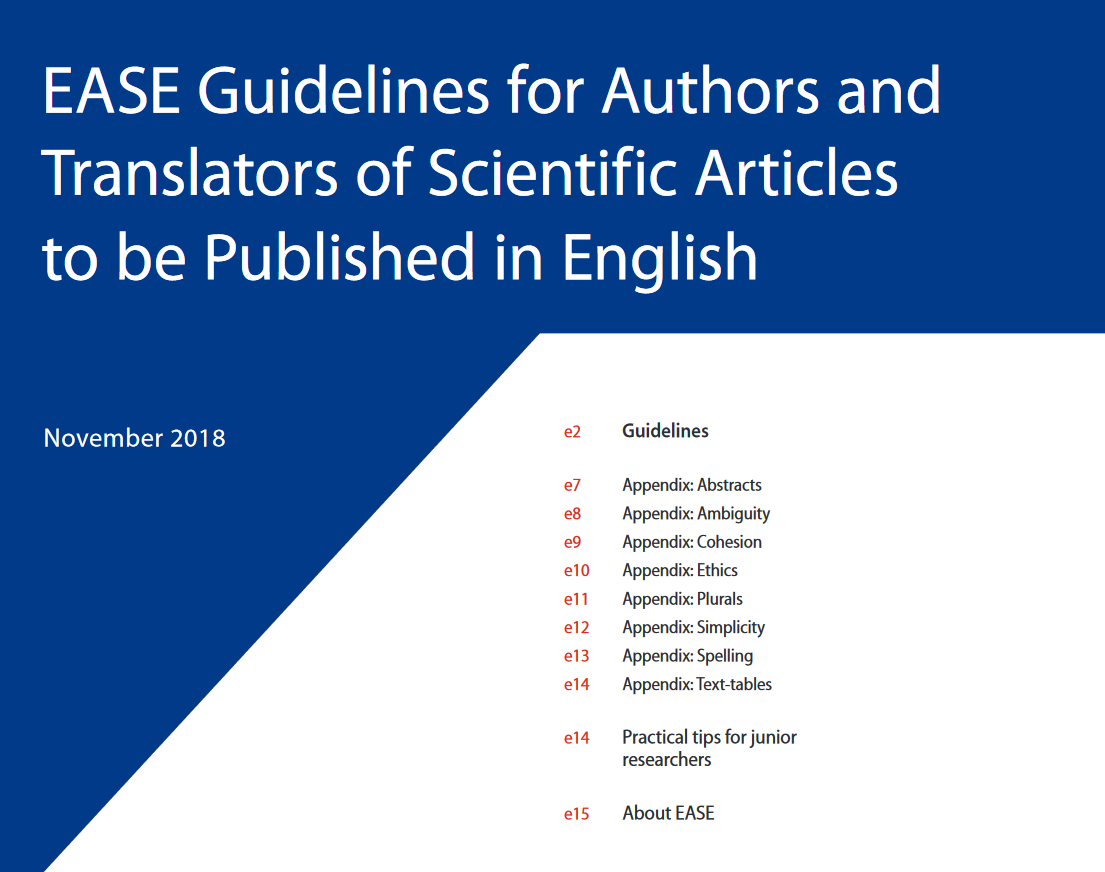
  • EASE Guidelines for Authors and Translators – New Dutch and Slovenian translations

    We have added two new translations of our hugely popular Guidelines for Authors and Translators of Scientific Articles. Our most recent additions are Dutch and Slovenian versions, which follow the Indonesian and Finnish translations published earlier this year.

    The EASE Guidelines for Authors and Translators of Scientific Articles provide simple, clear advice aimed at making international scientific communication more efficient. They also draw attention to ethical issues such as authorship criteria, plagiarism, conflict of interests and more.

    The guidelines were first published by EASE in 2010 and are updated annually. We now have 28 different versions of the Guide to better explain the subtleties of translation editing skills in the local languages of our members.

    Translations include Arabic, Chinese, Croatian, Japanese, Turkish, Romanian and many more. The Dutch and Slovenian translations can be found along with the 26 other languages on our Guidelines page HERE