Voting for our 2025 EASE Awards is now closed and the votes have been counted. Congratulations to all those nominated by our membership.

The Award winners will be announced at an online event on Wednesday, 11 February 2026. Register now and be part of a celebration.

Each winner will receive a digital certificate to recognise their achievement, and a number of new trees will be planted in our Global Forest to recognise all our winners.

Best EASE Initiative  – for a project or development from across EASE which has made a big impact on our community in 2025

Acceptance of European Science Editing into Web of Science

Editorial Board of ESE

We were delighted to announce that our EASE journal European Science Editing was accepted into the Web of Science Emerging Source Citation index in June 2025.

The journal can be found in the Web of Science Master Journal List now and will receive its first Impact Factor in the 2026 iteration of the metrics.

This achievement marks another milestone in our continuing efforts to enhance the presence and impact of our journal, following our conversion to full diamond-model open access with an ARPHA publishing platform in 2020, refreshed Editorial Board and appointment of new Editors, being awarded a DOAJ Seal, and most recently integration with Science Open just before our conference in Oslo, Norway in May 2025.
Editors' certification proposal

Past President, Professor Cem Uzun and his colleagues, particularly Yasin Hassan Balcıoğlu, have submitted an application to the COST Action Initiative (Horizon, Europe), to fund the development and implementation of a Certification scheme for journal editors.

This COST Action addresses the strategic European requirement to enhance trust, quality and integrity in scholarly communication processes by professionalising scientific journal editing. The Action will establish an open, interdisciplinary community of editors, researchers and publishers from across Europe to collaborate on building the first Europe-wide competence framework for scientific editor training and certification. By combining an approach that mitigates systemic issues (e.g. research integrity, responsible use of metrics, reproducibility, and the ethical integration of AI), the Action will facilitate the development of long-term editorial capacity across disciplines and regions. The Action will provide sustainable training, assessment and accreditation models to support policy alignment, editorial excellence, and the development of a transparent and robust European research environment.

The results will not be known until Autumn 2026, but we wish them every good luck in this important initiative.

GIST Guidelines, checklist development, conference session, webinar session, translations - DEI/RCPC

The GIST guidelines serve as a roadmap for quantitative intersectional analysis throughout the research process—from setting strategic research priorities and shaping research questions to data collection, analysis, and interpretation. A checklist was also developed to facilitate author and journal editor compliance with the guidelines.

A follow up article, Guidelines for Intersectional Analysis in Science and Technology: Implementation and Checklist Development was authored by Londa Schiebinger, Mathias Wullum Nielsen, Elena Gissi, Shirin Heidari, Richard Horton, Kari C. Nadeau, Dorothy Ngila, Safiya Umoja Noble, Hee Young Paik, Girmaw Abebe Tadesse, Eddy Y. Zeng, James Zou and Joan Marsh. It included a checklist to facilitate author and journal editor compliance with the guidelines. These guidelines are now published in the EQUATOR Network.

The GIST guidelines and checklist were presented by Londa Schiebinger at the 18th EASE Conference in May, 2025 in a session titled ‘How can you contribute to your journal’s sustainability‘ and by Mathias Wullum Nielsen in the EASE Webinar: Good reporting practice in October 2025.

The Regional Chapter network of EASE has made a number of translations and helped in disseminating this work to a wider audience.

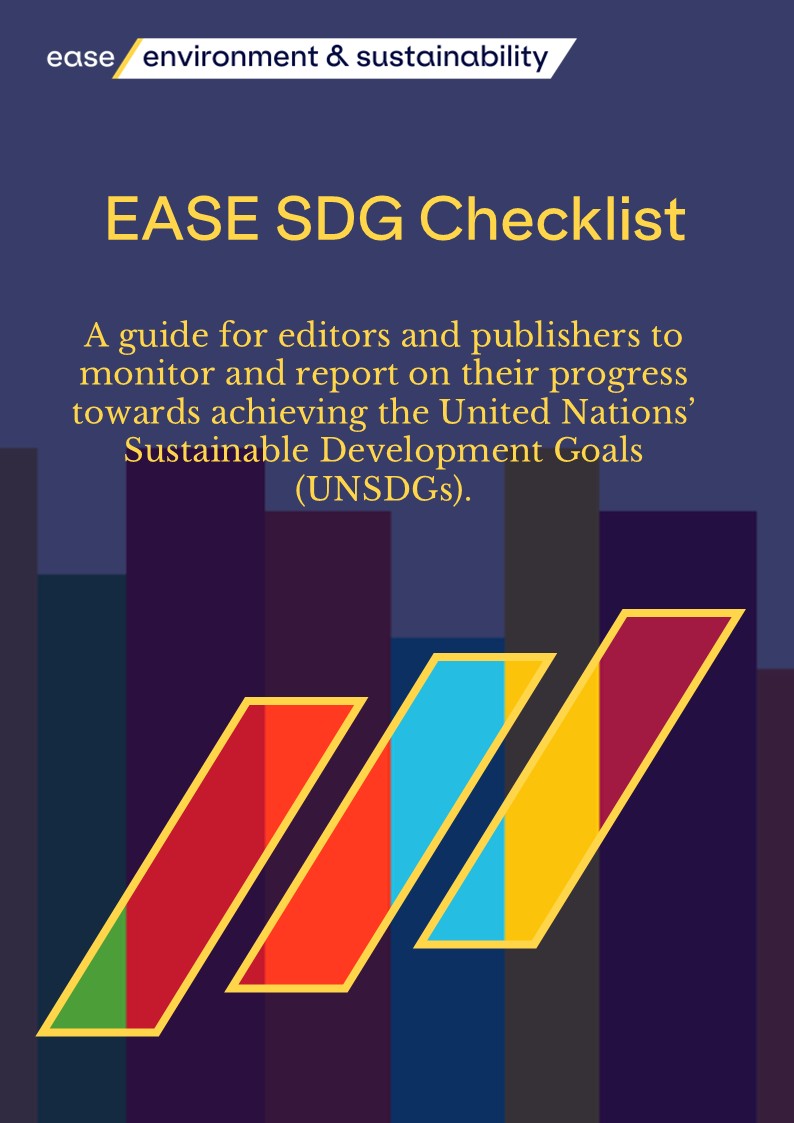
SDG Checklist

The EASE Environment & Sustainability (E&S) and the Diversity, Equirty and Inclusion (DEI) Committees joined together to create a new SDG Checklist to help editors and publishers monitor and report on their progress in achieving the United Nations’ Sustainable Development Goals (UN SDGs).

The Checklist is designed to provide practical, potential actions an organisation or individual journal might take. The actions are grouped under 4 high-level themes, with sub areas for easy navigation: strategy, environmental, EDI and communicating SDG knowledge.

The Checklist walks you through the themes, to enter and save your current status. Members are encouraged to complete the Checklist at different times: as a baseline, then maybe annually to track your progress over time.

Resource and publications translations

The Regional Chapter Programme Committee have been spearheading an initiative to translate a number of EASE publications and resources. This initiative aims to support the inclusive nature of EASE and its ability to reach out to those for whom English is not their first language. A number of different publications have been translated into many languages. More are anticipated in the near future.

Examples include:

  • Writing your research paper: tips from EASE editors
  • SAGER Checklist
  • The EASE Form for Authors’ Contributions and Competing Interest Disclosure
  • EASE Ethics Checklist for Authors
  • Recommendations on the Use of AI in Scholarly Communication.

Read more…

Community Contributor - awarded to a member who has been especially active in participating in or contributing to a wide range of EASE community activities in the year 2025

Bohdana Zahrebelna

Managing editor at Access to Justice in Eastern Europe Journal, Ukraine

Bohdana is nominated for her work to support EASE Ukraine and the Regional Chapter Programme Committee and her excellent engagement in the Editorial School for Journal Editors.

Anita Nagarajan

Communications and Editing Consultant, Educator, India

Anita is nominated for her work as chair of EASE India, including the translation of key EASE resources into several Indian languages.

Lovorka Čaja

Librarian, Dubrava University Hospital, Croatia

Lovorka is nominated for her work on behalf of the Environment and Sustainability Committee of EASE, including the design of their Conference Poster: Greening conferences ease’ing into sustainability and the production of a set of guidelines to support the community green their events.

Yasin Hasan Balcıoğlu

Assoc. Professor of Psychiatry, Deputy Editor, Dusunen Adam Journal of Psychiatry and Neurological Sciences, Bakirkoy Psychiatric Hospital, Turkey

Yasin is nominated for this work as an Associate Editor for European Science Editing, his chairmanship of EASE Turkey and his work on the Certification proposal.

Christina Kassiteridi

Senior Editor, Royal College of Physicians, UK

Services to the EASE DEI Committee, organising webinars and developing the DEI Awareness Raising Slide Deck.

Rising star - awarded to a member who has joined EASE in 2025 and quickly become involved in contributing to community initiatives in EASE

Seda Bahar Pancaroglu

PhD Candidate ; Co-Editor-in-Chief, Frame Journal, Çankaya University, Turkey

Sponsored member, Seda Bahar Pancaroglu joined EASE in August 2025 having participated in the first Editorial School for Journal Editors in March. She is nominated for her work on Turkish translations of EASE resources and publications and high engagement at both Editorial Schools and webinars.

Best original research paper or review paper published in 2025 as voted by EASE members

Visibility and research impact of Bulgarian geographers: insights from indexing databases and social media platforms

Authors: Hristina Prodanova, Stelian Dimitrov

Evaluating award-winning doctoral theses to reveal PhD research landscape: A case study of the Faculty of Medicine, University of Belgrade

Authors: Ranka Stankovic, Vukan Ivanovic, Ana Petrovic, Vladimir Nikolic, Katarina Milutinovic, Marija Jeremic, Lazar Davidovic, Nebojsa Lalic, Katarina Milutinovic, Tatjana Pekmezovic, Petar Milovanovic

Sex and gender reporting in neurosurgical journals: A cross-sectional study on enactment of the SAGER guidelines

Authors: Karlo Prižmić, Karlo Prižmić, Hrvoje Baric, Dorian Karuc, Michal Orlický, Andrei Ognean, Anda-Cosmina Hângan

Publishers' and editors' perceptions of equity, diversity, and inclusion: A cross-sectional study of European Association of Science Editors' community

Authors: Shelly Melissa Pranić, Ana Heredia, Charikleia Tzanakou, Pavel Ovseiko, Kate Wilson, Diana Samuel, Christina Kassiteridi

Balancing principles and practices: Disciplinary differences in Croatian researchers' attitudes to open-access publishing.

Authors: Lea Škorić, Miroslav Rajter, Bojan Macan, Jelka Petrak

Moldovan scientific conferences: Predatory or merely misguided?

Author: Gheorghe Cuciureanu

Review invitations from journals: A health sciences researcher's experience, 2022–2024

Author: Gina Joubert

Attitudes and perceptions towards the use of artificial intelligence chatbots in medical journal peer review: A protocol for a large-scale, international cross-sectional survey

Authors: Teresa Chan, Annette Flanagin,Alfonso Lorio, Cynthia Lokker, Hervé Maisonneuve, Ana Marušić, David Moher, Holger Cramer, Lex Bouter, Cynthia Lokker, Jeremy Y. Ng, Daivat Bhavsar, Neha Dhanvanthry

Policies on using artificial intelligence adopted by journals in psychiatry and mental health

Authors: Anuradha Baminiwatta, S. M. Yasir Arafat, Brady D. Lund, Chathuranga Costa, Dinuka Weerasinghe

Please note that EASE Council members were not included in the nominees for either the Rising Star or Community Contributor awards. Our Awards Scheme seeks to recognise those from within our community who have made a significant contribution to EASE during the Awards period.

Similarly papers authored by Council members, those on the Journal’s Editorial Team and the Editorial Advisory Board were not considered for the European Science Editing Best Paper award.