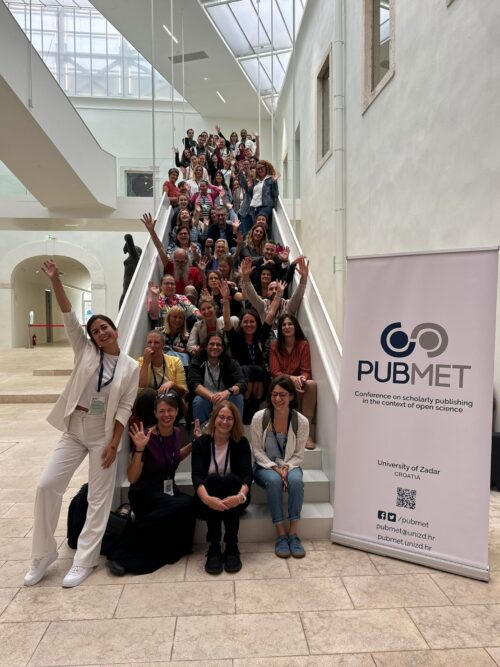
Exploring the evolving landscape of scholarly communication: highlights from PUBMET2024
The PUBMET2024 Summer School and Conference, held from 10 to 13 September, 2024, at the SEP building and II Palaces in Zadar, Croatia, marks a significant development in the field of scholarly communication, especially within the context of open science. This event introduced the first-ever Summer School on Scholarly Communication, preceding the 11th annual PUBMET conference on scholarly communication in the context of open science. The dual structure of the event emphasised both practical and theoretical approaches to critical issues in research and publishing, offering a comprehensive view of current challenges and innovations in the sector.
PUBMET2024 Summer School Overview
The Summer School was held from 10 to 12 September, and aimed to provide participants with in-depth knowledge on emerging issues in scholarly communication. Four key topics dominated the discussions: research integrity, rights and licensing, multilingualism and metadata.
Research Integrity
On the first day, the Summer School emphasised the importance of ethical research practices. With increasing concerns about research misconduct, the discussion focused on principles for maintaining integrity in the publishing process. A notable highlight was the session on the role of editors in conflict zones, where participants examined the challenges of neutrality and bias in war-torn regions like Ukraine.
Multilingualism in Scholarly Publishing
Day two explored how artificial intelligence driven tools are reshaping multilingual publishing. The growing global research landscape makes multilingual access more essential than ever, and AI tools such as machine translation offer innovative solutions for inclusive dissemination. This aligns with the broader trend in open science to make research accessible across different languages.
Rights and Licensing
In addition to multilingualism, the second day of the Summer School also addressed issues related to copyright and open licences. Participants discussed how licensing decisions impact the distribution and visibility of scholarly works, and examined best practices for balancing intellectual property rights with the ethos of open access.
Metadata and Indexing
The final day of the Summer School addressed the technical challenges associated with publication indexing, visibility, and data interoperability. With scholarly works becoming increasingly digital, the session emphasised the importance of persistent identifiers and metadata in improving research discoverability. Practical workshops guided participants on how to effectively manage metadata and ensure their research reaches the right audiences.
PUBMET2024 Conference Overview
The PUBMET2024 Conference, held on 12 and 13 September, was the 11th edition of this annual event, continuing its tradition of bringing together scholars, librarians, publishers, and policymakers to discuss the future of scholarly communication. This year’s focus was on research assessment reform, a timely and critical issue within academia.
Research Assessment and Openness
The first day opened with a session on the intersection of openness and research assessment. Keynote speaker Bianca Kramer addressed how open science can influence the transparency and fairness of research assessments. The discussion included efforts to enhance the visibility of Diamond Open Access (OA) journals, which offer free publication and access without Article Processing Charges (APCs), but face challenges in sustainability and recognition. Croatian Medical Journal’s experience with open peer review was also explored as a case study in increasing accountability in research evaluations.
Integrity and Ethics in Research Assessment
A panel session, chaired by Matt Hodgkinson, tackled the ongoing challenges of maintaining integrity in research assessments. The panellists – Fotis Mystakopoulos, Iva Grabarić Andonovski, Lynne Bowker and Svjetlana Kalanj Bognar – focused on ethical standards, best practices, and the growing need for transparency, especially in light of the increasing pressure on academics to meet certain performance metrics.
Diverse Perspectives on Research Assessment
The second day of the conference featured a keynote by Emanuel Kulczycki, who discussed how historical and regional differences shape research assessment reforms, especially in Eastern Europe. This was a significant contribution, as much of the research assessment reform conversation has been dominated by Western perspectives. The need for diverse approaches was further underlined by panel discussions highlighting the integration of open science practices into traditional evaluation systems, such as Serbia’s national Current Research Information System (CRIS).
Poster Session and New Initiatives
PUBMET2024 also featured an interactive poster session, where researchers shared new insights into data management and scholarly communication. Among the highlights were presentations on Crossref’s role in strengthening research integrity through metadata and a project from Croatia focused on developing bibliometric tools for clinical research. The session showcased innovations from across Europe, emphasising the importance of collaboration and open infrastructure.
Reimagining Research Assessment
Closing the conference, Erzsébet Tóth-Czifra delivered a keynote on shifting from productivity-driven metrics to quality-driven assessments. The discussion was forward-looking, envisioning a future where academic success is measured by integrity, transparency, and community-driven workflows rather than sheer output.
Conclusion and Future Directions
PUBMET2024 successfully combined academic rigor with practical solutions, providing a platform for scholarly communication experts to exchange ideas and learn from each other. The introduction of the Summer School was a valuable addition, offering participants a more focused learning experience on contemporary challenges. Meanwhile, the conference continued its tradition of addressing pressing issues such as research assessment, offering new insights and fostering a collaborative environment for future innovation.
The themes discussed at PUBMET2024 underscore the importance of integrating ethical standards, inclusivity, and transparency into research practices. As the academic landscape continues to evolve, PUBMET remains at the forefront of these conversations, contributing to the broader open science movement. Looking ahead, participants and organisers expressed optimism about the future of scholarly communication and are already anticipating further developments at PUBMET2025.
Authors:
Ivana Končić, Ruđer Bošković Institute, Croatia
Martina Žugaj, Ruđer Bošković Institute, Croatia
Lovorka Čaja, Ruđer Bošković Institute, Croatia