-
 EASE UA Update: Navigating the New State Regulations and the Overhaul of the National Journal List22 June 2026Integrating Ukrainian science into the global landscape requires more than just regulatory changes; it demands a profound transformation of our editorial culture.
-
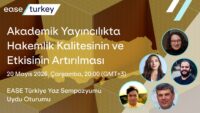 EASE Türkiye satellite session: Improving Peer Review Quality and Impact in Scholarly Communication24 May 2026The EASE Türkiye satellite session was delivered by Esma Şenel on 20 May 2026. It focused on reviewer training in foreign language education and introduced Peer Review Lab, a structured reviewer training model developed by Şenel as part of her doctoral research. The session addressed the relevance of reviewer training to scholarly communication, editorial quality, research culture, and the wider EASE theme of quality and impact.
-
 From Theses to Products: What Changing Doctoral Models and AI Limitations Mean for Academic Editors13 May 2026China’s experimenting with a no-thesis PhD, where the focus will instead be on an end product. Although such approaches are often associated with engineering and technology disciplines, we can think of “products” for humanities disciplines in terms of policy frameworks, intervention programmes, public humanities initiatives, archival systems, social impact projects, educational tools, or governance models.
-
 10th anniversary celebrations of the publication of the SAGER guidelines23 April 2026In ten years, the SAGER guidelines have recorded nearly 1.4 million unique accesses, more than 1800 citations, and have been adopted by leading journals, including the Lancet, the BMJ, Nature, and Cell, and major publishers across multiple disciplines, spanning an estimated 9,000 journals. The guidelines have also been adopted by research institutions, including the World Health Organization and its latest addition of the Swiss Tropical and Public Health Institute, reflecting growing recognition of the SAGER guidelines as a research quality standard.
-
 Qualitative research recommendations7 April 2026Recently, The Lancet has paid growing attention to the role of qualitative research in health sciences, highlighting its importance for understanding patient experiences, clinical decision-making, and aspects that may not be captured by quantitative approaches alone.
-
 Self-Disclosed Use of AI in Research Submissions to BMJ Journals26 March 2026AI use in research submissions to medical journals appears to be significantly underreported. This study examined 25 114 research manuscripts submitted to 49 BMJ Group journals, founding that only 5.7% disclosed AI use, even if previous studies suggested data ranging from 28% to 76%.
-
 The gatekeepers of global health knowledge: A systematic review of diversity in editorial boards26 March 2026Editorial boards influence global health research by deciding what gets published, and whose knowledge is prioritized. The ongoing underrepresentation of scholars from minoritized backgrounds raises concerns about the systematic exclusion of certain researchers and perspectives.
-
 Greater transparency for oncology clinical trials reporting26 March 2026The CONSORT guidelines may not fully address the complexity of modern oncology studies and they lack requirements for details that would allow readers to make...
-
 Five ways to spot when a paper is a fraud26 March 2026The good news is that recognizing a problematic manuscript is “way easier than you would believe”, says Stephanie Melchor in this paper published on “Nature”. Then she lists some strategies that can help...
-
 The importance of SPIRIT-C and CONSORT-C for child health and equity26 March 2026The new SPIRIT-C and CONSORT-C guidelines are extensions of the SPIRIT and CONSORT frameworks for studies that include neonates, infants, children, and adolescents.
-
 Building Reviewer Competence for Early-Career Researchers in Foreign Language Education: An Expert-Based Needs Analysis9 February 2026This article is based on my doctoral research in English Language Education and focuses on an expert-based needs analysis conducted prior to the design of a peer review training program for early-career researchers (ECRs) in foreign language education.
-
 Our EASE Forest grows…5 February 2026Through our planting partners, Plant for the Planet, we are delighted to have planted 266 new trees in Uganda. A key part of this project is the biodegradable system that their team have developed, which allows them to avoid the use of many plastics and generate added value to local communities.
